Friday, 25 April 2014

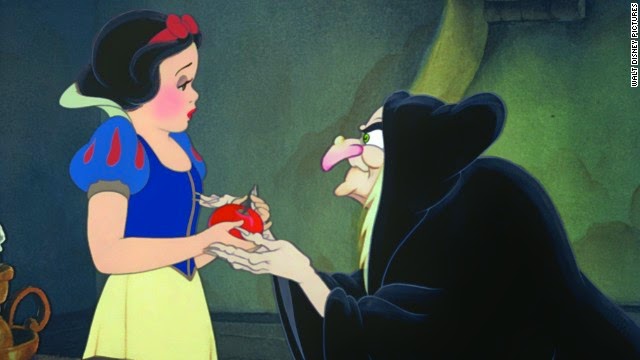
Snow White and the Seven Dwarfs (1937)

Country: USA
Based on: Snow White by the Brothers Grimm
Director: David Hand (supervising)
Producer: Walt Disney / Made by Walt Disney Productions / Distributed by RKO Pictures
Screenplay: Ted Sears and seven screenwriting dwarfs (no really, there were 8 screenwriters)
Voices: Andriana Caselotti, Lucille Le Verne, Harry Stockwell
Length: 83 minutes

Summary/Logline:
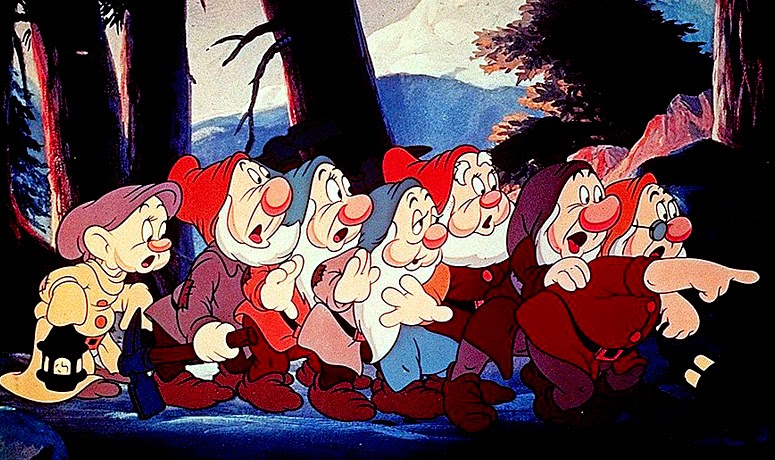
A beautiful young princess flees the narcissistic, homicidal rage of her Queen mother and takes refuge with an eccentric group of forest-dwelling little people en route to meeting her Prince Charming. 

Background/History
On the heels of Disney’s hugely popularly Silly Symphonies shorts, Snow White was not only Walt’s first animated feature, but the first animated feature, period. Filmed on a budget of $1.5 million, it initially raked in $8 million and another $408 million since, making it one of the top ten highest grossing films in North America (when rated for inflation). Before its release, naysayers considered it little more than an outrageously priced flop-to-be. But Disney had faith, and he mortgaged his house to prove it.
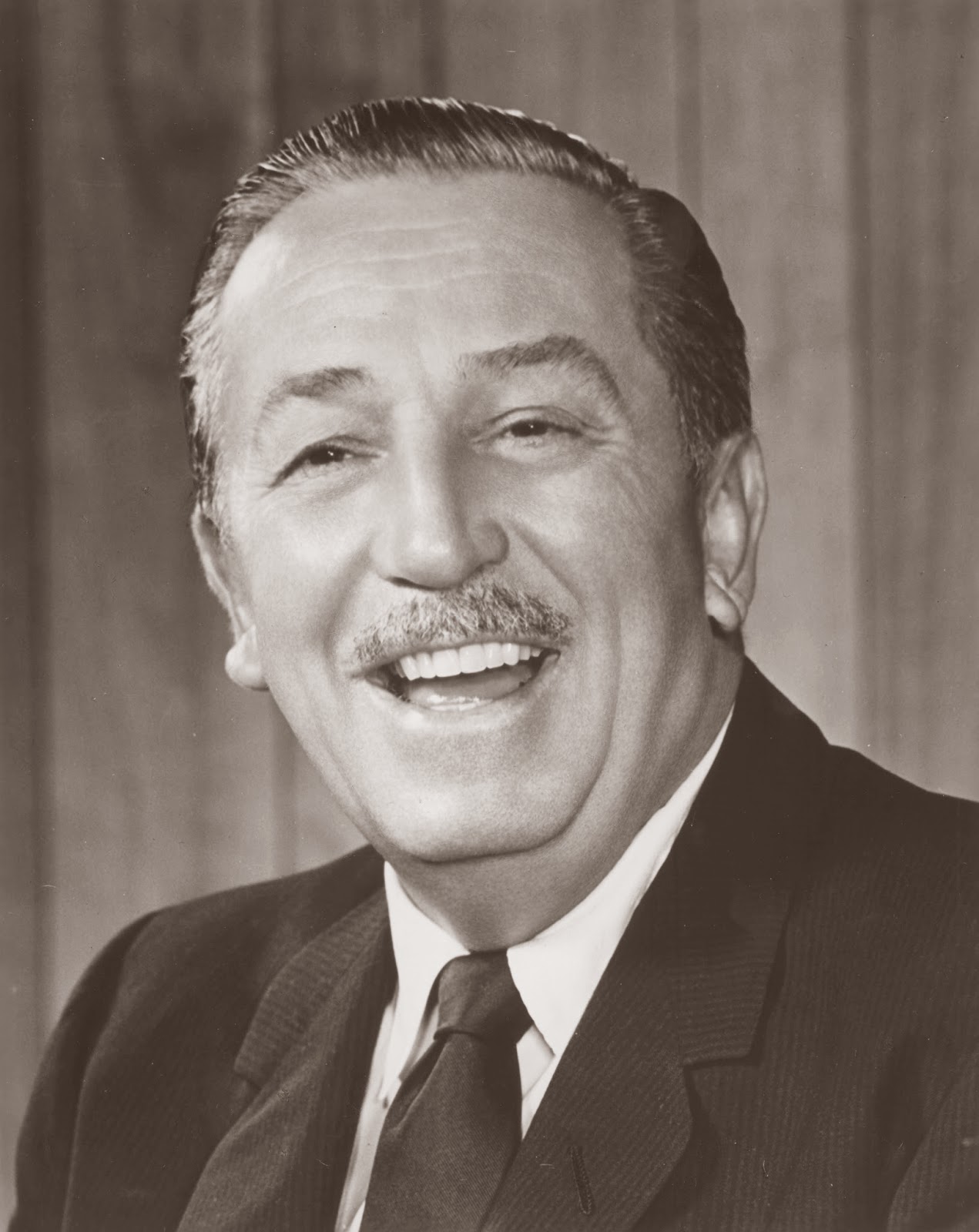
Production started in the summer of 1934 with mostly untrained animators whose only professional experience was as newspaper cartoonists. To make sure his crew was up for the task, head animator Art Babbit held classes in his home using a female model. While the dwarfs were the film’s primary selling feature, the heart of the story was Snow White’s rocky relationship with her stepmother, the Queen. Eager to strike a balance between comedy and drama, Walt ensured the movie would make audiences laugh, scream and cry in equal measure.  The film was re-released every seven to ten years between 1944 and 1993, when it became the first film ever to be digitally restored.

Winner of an honorary Oscar in 1939 and nominated for Best Musical Score, largely due to classic songs like Some Day My Prince Will Come, Whistle While We Work, and Heigh Ho, Snow White’s profits were used by Disney to finance the now-legendary Walt Disney Studios in Burbank, California. Over the next 16 years, Disney would forever cement himself in the popular imagination with classics like Pinocchio, Fantasia, Dumbo, Bambi, Alice in Wonderland and Peter Pan. 

HIM:
Trying to pin down Disney’s influence on cinema and society, never mind on me personally, is roughly the same as trying to summarize the value of air. I can’t remember a time when Disney wasn’t a major part of my life and a fundamental artistic influence. Nor for that matter do I particularly want to. When I’m feeling blue and need me a good pick-me-up, Disney films are still my number one go-to. Walt’s much-chronicled journey from school newspaper cartoonist to roadblock-jumping businessman to shaper of dreams is legendary, a roadmap of perseverance and self-belief if ever there was one. (P.S. I cannot recommend Neal Gabler’s Walt Disney: The Triumph of the American Imagination highly enough.) His inexhaustible desire to transform the American cultural landscape, on display in his films, theme parks, television programs, and more, was both unprecedented and unparalleled, except by history’s other notable (if not so noble) emperors.  
And yet despite his insatiable commercial appetite and grand ambition, he never lost sight of what mattered most: touching, well-crafted, highly entertaining stories rooted in ancient archetypes and popular fairy tales that somehow managed to appeal to everybody. And of course, I do mean everybody. So deep was his influence that nearly half a century after his death in 1966, The Walt Disney Company is still spinning cinematic gold out of Walt’s original vision. Sure, the journey hasn’t been without a few dry spells, and one can’t ignore the revival that was Pixar, but on the whole, Disney has remained an institution and inspiration for millions of aspiring storytellers, animators, and filmmakers, not to mention that little kid in all of us.    

But I digress. Snow White, Disney’s bold first kick at the can must have hit audiences like a comet. Funny, moving, visually mesmerizing, and narratively rich, it tells the simple story of a young woman handed one shit sandwich after another who absolutely refuses to let it bring her down. Ignore for a moment that she spends a good share of her time cleaning up after men, for to do otherwise would miss the deeper message. Independent, resourceful, generous and genuinely happy all at the same time, she’s about as close to a perfect female role model - or role model, period - as I can imagine. Sure, she wouldn’t mind a Prince Charming in her life (is that a bad thing?), but she's clearly able to manage just fine on her own in the meantime. The dwarfs are cute and hilarious, the Queen is suitably wicked, and Prince Charming is, well, charming. But it’s Snow White herself that steals the show, and I love her for it.

Too often, we roll our eyes at Disney’s myriad pretty princesses, superficially viewing them as some kind of affront to feminism. But I would argue the opposite: that there is no other filmmaker or studio in history that has so consistently placed strong, heroic female leads at the center of their stories, and who who almost always save the day. Think Alice, Pollyanna, Mary Poppins, Miss Bianca, Ariel, Belle, Pocahontas, Mulan, Nani and Lilo, Mia, Giselle, Tiana, Rapunzel, Merida, and most recently, Elsa – never mind their many sinister and colourful female antagonists. In this way among many others, Walt Disney was a kick-ass, cutting edge innovator.

At the same time, I love Snow White’s unbridled zest for life, her Buddha-like ability to revel in the moment, and the story's emphasis on the elevating power of friendship and community in the face of overwhelming evil. It’s a massively entertaining and elegant film with a beautiful message, uplifting tunes, and wholesome laughs. And these days, who couldn’t use a bit more of that?

HER:
When I was growing up, Snow White was the Disney princess I could identify with most. She always focused on the positive even when things were truly bleak. She loved animals and they loved her back. (Bonus: they sang with her and helped clean the house!). She had a thing for apples. And she was always so darned polite!
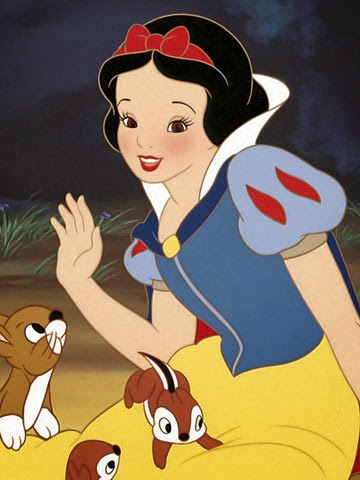
But what surprised me most about seeing Snow White and the Seven Dwarfs again after all these years was how truly independent and full of joy she comes off in the film - not just as a woman, but as a human being. She's not bothered by what others think she should be, one way or the other; she just is. She doesn't clean and cook and sweep because it's expected of her as a woman; she does it because she genuinely enjoys it. Intentionally or not, she stands for all women who may, in the end, find their truest joy in a role society now sadly deems "stereotypical" and "sexist": that of homemaker, mother, and hostess.

There's also a great little message about how karma works. Snow White sends love out into the world and it comes back to her in multiples of seven - plus Prince Charming! She radiates joy and the people around her can't help but reflect it back. I love that. I know life doesn't always work that way, but Snow White is a good reminder that it can if we're willing to risk throwing a little positive energy out there every once in a while. Whether we get a Prince Charming in the end or not, that just seems like a better, and certainly a happier, way to live.

Sunday, 20 April 2014

Modern Times (1936)

Country: USA
Director: Charlie Chaplin
Screenplay: Charlie Chaplin
Starring: Charlie Chaplin, Paulette Goddard, Henry Bergman
Length: 87 minutes 

Summary/Logline:
A blue collar worker (a.k.a. the Tramp) struggles to make ends meet for him and his sweetheart in an increasingly mechanized and dehumanized world. 

Background/History: 
His first (sort-of) talkie and explicitly political film, Modern Times was inspired by Chaplin’s distressed observations of Europe during the Great Depression while promoting City Lights (1931), and by a conversation with Gandhi lamenting the profit-driven industrialization of society. Arguably his most popular film, Modern Times inspired cultural phenomena like Jean-Paul Sartre’s journal, Les Temps Modernes and the famous “chocolate assembly line” episode of I Love Lucy.

HIM:
If Fritz Lang’s Metropolis (1927) and Chaplin’s City Lights (1931) got it on and had a baby, they would have to name it Modern Times. I'm no enemy of free enterprise (even though I'm about to sound like one), but if anything could turn me into a flag-waving communist, it's this oldie but goodie. Chaplin’s indictment of industrialization, crony capitalism, and the exploitation of workers (symbolized not-so-subtly by a herd of sheep, one notable black one among them), Modern Times must have profoundly resonated with a Depression-era population desperate for work and often left to feel like mere cogs in the Great Industrial Machine - in the Tramp's case, literally.

As in Metropolis, business magnates look for cheaper and better ways to squeeze the most out of their workers. We also see a female freedom fighter working tirelessly to defend the socially-disadvantaged masses while struggling to put bread on her own table. This is a world in which there is no middle class, just a handful of Richie Riches and everyone else. (Sound familiar?) To be an "employee" is to barely subsist, which means you might just have to turn to a life of crime if you want to feed your family. Who cares if you go to jail, Chaplin concludes, at least that way you eat. The poor guy doesn’t want much, just a job that pays a decent wage and a home he won’t lose to the bank. Filthy socialist!

But there’s something else we should notice here. The fact that a man as well-off as Chaplin could tell a probing story about working class problems suggests that there was, once upon a time, an era when the wealthy registered enough concern about the rich-poor divide to talk honestly about it. A stark reminder that our experiment with democracy and social welfare over the past couple of centuries has been short-lived and that the rich and powerful will always find a way to build million-dollar condos atop the carcasses of the poor bastards who helped get them there.

Don't get me wrong, I love money. I just hope my humanity doesn't drown if I find myself swimming in it.

HER:
And he does it again! Chaplin had an undeniable knack for combining laughs, a well-constructed plot, and a great big heart in all of his films. Case in point: a midpoint scene in which a former co-worker robs the department store the Tramp is now guarding, claiming not to be a criminal and just needing to feed his family. It's a moment that has you chuckling one minute and fighting tears, the next. Classic Chappy!

The opening assembly line scene isn't just a classic, it's farkin' hilarious, as funny today as it was 80 years ago, showing that when it came to comedy, Chaplin just got it. I also love that he rather consistently steers away from reducing his female characters to props, choosing instead to give them strong, decisive and, dare I say, equal importance in his stories.

It was heartbreaking to learn of the opposition Chaplin faced during the second half of his career thanks to Senator Joseph McCarthy and all of his friends. But maybe the persecution he endured was part of what made him such a brilliant storyteller, who knows? Either way his films still resonate as some of the most creative, honest and authentically human of the twentieth century. Discovering great movies like Modern Times was exactly why we started this blog. Thank you, Charlie!

Sunday, 13 April 2014

It Happened One Night (1934)

Country: USA
Director: Frank Capra
Based on: Night Bus, a short story by Samuel Hopkins Adams
Screenplay: Robert Riskin
Starring: Clark Gable, Claudette Colbert, Walter Connolly
Length: 105 minutes

Summary/Logline:
The spoiled daughter of an overbearing millionaire runs away and falls in love with a surly reporter on a wild road trip from Florida to New York.

Background/History:
This seminal romantic comedy won the “big five” Oscars in 1935 (Best Picture, Director, Actor, Actress, and Screenplay), a feat equalled by only two other films: One Flew Over the Cuckoo’s Nest (1975) and Silence of the Lambs (1991). Gable and Colbert landed the lead roles only after heavyweights like Robert Montgomery, Margaret Sullavan, Carole Lombard, and Bette Davis were unable to commit. One of the last rom-coms screened before the MPAA started enforcing the infamous Hays Code (which would have censored out Claudette Colbert’s famous leg shot), It Happened One Night was initially a critical and box office blah. However, the film quickly picked up steam and became Columbia Pictures’ biggest success at the time, earning $2.5 million on a $325,000 budget.

HIM:
There’s an old adage that says comedy doesn’t age well. For proof, look no further than It Happened One Night, the “original” romantic comedy in which women are either spoiled brats, unhinged lunatics, or jaded old maids - in short, children. Correspondingly, men exist to rescue, discipline, and think for women, when they’re not spanking them (or threatening to), that is.

Try as he may, writer Robert Riskin’s attempts to make Ellen intelligent, independent, and occasionally averse to Gable’s endless chauvinism drown in the relentless stereotypes of the era. Her actions constantly contradict her words. In a camping scene, Ellen tells Peter she doesn’t need him and that he can leave at any time before turning into a panicky mess when she can’t immediately locate him. And forgive my heresy, AFI, but the “classic” sexy-female-leg-stops-a-car scene made my eyes come this close to rolling out of my head. That and the fact that after only two days with the paternalistic Peter, she can’t imagine living without him.

So how did It Happened One Night end up on our and many other “most important” lists? Primarily because it wrote the blueprint for all future rom-coms. You’ve got your lovers starting as far apart as possible, zingy sparring and bantering, road-trip antics, compounding male chivalry, a few solid comedies-of-errors, near-end misunderstandings, and a final recognition that they were always meant to be together. There’s even a wedding stopped in the nick of time for our lovers to reunite. (Think The Graduate meets Runaway Bride.) Groundbreaking, genre-building stuff and a few good laughs.

Unfortunately, the sexism is so thick and pervasive, no matter how hard I tried to contextualize the film in historical terms, I simply couldn’t enjoy it. I’ll agree that It Happened One Night is an important film, but not only because it helped establish a genre: it was also the unintentional arch-promoter of a thousand gender stereotypes and an unfortunate rogue-rescues-female formula, both of which have plagued Hollywood and society ever since. 

HER:
Ugh! Here's the way it works: I'm never, ever, EVER going to like a movie where a "brat" (by 1930s definition, a woman) gets spanked, threatened, scolded and cajoled by her Knight in Shining Armour. Not now, not in any of my former lives, not if the AFI paid me a million dollars, not if the CIA tortured me slowly on a spit over molten hot lava. Eye-rolling, exasperating bulls**t. Did I stutter? (Drops mike and saunters off stage.)

World Premiere: The Two Pauls, Episode 2 - Sex, God & Superheroes

Paul Jensen and I go head-to-head on some of the biggest (and most controversial) upcoming films of 2014 over one white and two reds!

See Episode 1 (Oscar Edition) here. Meanwhile, see The Story Behind The Two Pauls below. Big thanks again to the tireless crew at Popkin Media!


The Story Behind The Two Pauls
by Paul Donnett

When Vancouver Film School grad and savvy entrepreneur Nick Carey approached film Jedi Paul Jensen about doing a Siskel and Ebert-style web series featuring reviews of films past and present, the man with the exhaustive Star Wars action figure collection literally hidden in his bedroom closet jumped at the opportunity. Bonus: Each episode would feature a bottle of wine, specially paired with the movie in question.

But who would sit in the other chair, they wondered? Who could match wits with Sir Jensen's freakishly encyclopedic mind and show each film its due reverence, whilst remaining j-u-u-u-st sober and coherent enough to bring each episode to a thrilling climax?

The choice was obvious. After all, if there's anyone who knows about thrilling climaxes, it's this guy. Paul and I had actually talked about forging such a venture a year and a half earlier and now, thanks to the fine people at Popkin Media, the two Pauls were about to get their wish! My only condition: one bottle of wine simply wasn't enough.

So Paul, producer Nick Carey, and I met over drinks on Tuesday. Followed by more drinks with Popkin partners Patrick Do and Ben Gaumond on Friday. Followed by an all-day Saturday shoot that took The Two Pauls from concept to production in under a week. Never in my experience has a project come together so quickly, so seamlessly, and with such an enjoyable group of highly competent, over-caffeinated egomaniacs!

Subscribe to Popkin Media to catch future episodes of Film Night With The Two Pauls

Saturday, 5 April 2014

Duck Soup (1933)

Country: USA
Director: Leo McCarey
Screenplay: Bert Kalmar, Harry Ruby, Arthur Sheekman, Nat Perrin
Starring: Groucho Marx, Harpo Marx, Chico Marx, Zeppo Marx, Margaret Dumont
Music: Bert Kalmar, Harry Ruby
Length: 68 minutes 

Summary/Logline: 
President Rufus T. Firefly fights to save the nation of Freedonia from a hostile takeover by the imperialistic ruler of Sylvania. 

Background/History: 
Undisputed masters of Vaudeville stage comedy, the Marx Brothers' relentless puns and slapstick antics laid the groundwork for a thousand comedians and comedy acts to come. Following up on the success of Horse Feathers, Paramount’s highest grossing film of 1932, Duck Soup was initially a critical and box office disappointment. It has since become one of the most important and influential films in cinematic history.  

HIM: 
The same year my father rendered me catatonic with Frank Langella's Dracula (see our review of Nosferatu - 'nuff said), he yinned that yang by shuttling me to Vancouver’s now sadly defunct Ridge Theatre one Sunday afternoon and introducing me to a phenomenon that would brand my concept of funny for time and eternity. It was the Marx Brothers, starring in a whopping three-course meal of Monkey Business (1931), Horse Feathers (1932), and Duck Soup (1933). I was nine years-old but by the time the last reel finished, I couldn't wait to grow a grease-paint moustache and smoke my first cigar.

My first thought was, "Man, these guys are hilarious, but why do they keep copping gags from Bugs Bunny?" Of course, I couldn't have then known that it was actually the other way around: that Looney Tunes - like Monty Python, Robin Williams, Gabe Kaplan, Jerry Seinfeld, Jim Carrey, and countless others - drew inspiration from a quartet (originally a quintet) of comedy geniuses way, way ahead of their time.

It's safe to say that the Marx Brothers helped shape and distinguish one of two distinct, if subtle, streams of comedy in cinema's early history. On the one hand was the heartwarming comedy-with-a-message of Charlie Chaplin in films like The Kid (1921), City Lights (1931), and The Great Dictator (1940). On the other, was the silly, absurdist humour of the Marx Brothers and the Three Stooges, where the laughs existed for their own sakes, rather than serving a larger narrative purpose. With Chaplin, laughs were important but story was number one. With the Marx Brothers and the Stooges, laughs were everything, story be damned.

I recognize Groucho and company aren't everyone's cup of tea. But call me sentimental, I just can't get enough of 'em. And on that note, hello, I must be going!   

HER:
Before I met the Donnett clan, I had never heard of The Marx Brothers. I came from a Three Stooges-lovin' family and, therefore (obviously), didn't need to look any further to get my fill o' slapstick hilarity.
So, needless to say, Duck Soup was my first Marx experience. And what a first it was! Not short on moments of outrageous sexism, I have to admit Groucho was an equal opportunity guy when it came to spreading the insults around. (I guess that's a good thing?)

All in all, I found the story exciting and the physical humour both clever and original. As a benchmark for physical comedy beyond the 30s, I can definitely see why it made it to the list. And given the political climate of the times, I can see why this film proved popular then and now. Still, I'll take the Three Stooges over The Marx Brothers any day. But don't tell "Him" that! 

"Nuk, nuk, nuk!!"

Monday, 31 March 2014

King Kong (1933)

Country: USA
Director: Merian C. Cooper, Ernest B. Schoedsack
Producer: David O. Selznick
Screenplay: James Ashmore Creelman, Ruth Rose
Starring: Fay Wray, Bruce Cabot, Edgar Wallace
Length: 100 minutes

Summary/Logline:
A director and his film crew travel to a mysterious island and return to New York with a really big ape who just can't get enough of Fay Wray.

Background/History:
King Kong hit audiences at a time when nature documentaries (popularized by the Lumière brothers) and jungle adventure films were very much in vogue, including 1913’s Beasts in the Jungle, 1918’s Tarzan of the Apes, and 1925’s The Lost World. Inspired by the fantastical trick photography of director Georges Méliès in films like 1902’s Voyage dans la lune, Selznick and Cooper enlisted special effects guru Willis O’Brien and team to marry stunning matte-painted backgrounds with cutting edge stop-motion animation, finely-detailed miniatures (including animals, people, and entire sets), and robotics. Meanwhile, composer Max Steiner was paid $50,000 to write the original score.

Made in eight months on a budget of $672,000, King Kong earned $2.8 million at the box office. Canadian actress Fay Raye had the looks, charm, and scream to win her the part of Ann Darrow. Peter Jackson offered her a role in his 2005 remake but she passed away shortly before filming began. Two days after Wray’s death (Aug 8, 2004), the Empire State Building’s lights were dimmed in her memory. Kong was remade in 1976 with Jeff Bridges and Jessica Lange, and again in 2005 with Naomi Watts and Adrien Brody.

HIM:
As a movie about people making a movie and getting w-a-a-a-y more than they bargain for, King Kong is more than just the first great monster film; it’s also the first great meta-narrative monster film. (Say thank you, Blair Witch, Cloverfield, Paranormal Activity, et al!) As an example of early cinema’s radical visual evolution, few films equal Kong with its unprecedented special effects, groundbreaking shots of Kong in motion from inside plane cockpits, and seamless composite editing.

Story-wise, however, Kong is a mixed bag. Part of me loves the film and part of me is left scratching my head. Great pacing, wicked suspense, and wow, does this plot move! But, in the end, what is Kong about? What are the deeper meanings, the broader themes? The big ape’s journey is so firmly entrenched in pop culture, so revered and legendarily awesome(!), it’s a bit harrowing to critique, never mind imagining how audiences must have first reacted to the film's basic, central idea.

As our next few reviews will demonstrate, the “important” films of the 30s were awash in epic, eyeball-rolling sexism, Damsels-in-Distress (i.e. every woman) constantly requiring Savior-Rogues (i.e. any man), and such. With this in mind, lacking any definitive message aside from the weak and incomprehensible addendum, “it wasn’t the planes, it was beauty killed the beast”, King Kong may serve most significantly as an ironic if unintentional metaphor for the age: that men spent most too much of their time thumping their chests and protecting “their” women like mindless, macho animals, when they could have been behaving like human beings and enjoying something akin to functional, fulfilling relationships.

I get that the film is also trying to say something about the evils of western colonialism, capitalism gone wild, the exploitation of nature, and the disenfranchisement of those whom society deems unacceptable. But in the end, the film is a triumph of style – albeit wonderful, revolutionary style - over substance. Sure I was a little sad when (spoiler alert!) Kong fell to his death, but unlike Peter Jackson in 2005, director Merian Cooper hadn’t given me much of a reason to care about Mr. Big, so I didn’t. 

Having said that, I don’t doubt there would have been a rosebud or two in my pajamas when Kong first appeared had I been in the audience in 1933!  
HER:
First, the good news. Cool special effects!
Now for the fun part. I'm supposed to believe that, in the 30s at least, a man could easily find and lure a woman from a homeless shelter to his boat, destination unknown, simply by offering her a cup of coffee and a starring role in his "next big film"? And that this same woman would be subsequently treated like a princess by a boatload of sailors? How about no?

And then there are those wicked stereotypes about minorities (look, a "China Man" in "authentic" Chinatown regalia) and indigenous peoples (feast your eyes on these bloodthirsty island savages). That and the skipper's bizarre ability to suddenly speak the native language of an island he didn't even know existed ten minutes prior.

And the end of the story? In a word, totally unsatisfying. (Okay, two words.) I mean, what was this movie about? Big mechanical gorillias with bad hair and bristol board teeth? I get that it was supposed to be about a classic beast protecting a classic beauty, but I got no real sense of this until 45 seconds before the closing credits began to roll. Until then it just seemed that Kong saw her as a toy to play with, and one that he wasn't particularly interested in until the schoolyard bully came along, in this case, a T-Rex with those freakish carny arms.


In short, I felt King Kong lacked a meaningful theme, point, or redeeming lesson - except, of course, that if one lives on the twentieth floor of a luxury apartment, he or she should probably keep their bedroom window closed, lest they be plucked from their slumber by a giant, hairy hand and meet with an undesirable demise. 

Thursday, 27 March 2014

City Lights (1931)

Country:  USA
Director: Charlie Chaplin
Screenplay: Charlie Chaplin
Starring:  Charlie Chaplin, Virginia Cherrill, Florence Lee, Harry Myers
Length: 87 minutes 

Summary/Logline: 
A homeless man falls in love with a blind girl selling flowers and goes through hell to help her pay rent before she is evicted. 

Background/History: 
Opting to stay silent when sound films were already popular (Chaplin believed “talkies” were merely a fad), City Lights was an instant box office smash, earning over $5 million or more than three times what it cost to make. Albert Einstein was at the premiere. Chaplin was beloved of directors like Orson Welles, Stanley Kubrick, Federico Fellini and Woody Allen. His mother Hannah died during pre-production and the film was put on hold. Some have suggested that the film is partially autobiographical, with the flower girl representing Chaplin’s mother.


HIM: 
Chaplin's signature character, The Tramp, had already appeared in Kid Auto Races at Venice (1914) and served as the comical heart of dozens more films to follow. But he was more than the guy with the little moustache and cane: Chaplin was a Hollywood powerhouse for decades as actor, producer, distributor, part owner of United Artists, and if that weren't enough, composer for his 1931 classic with Arthur Johnston. 

City Lights is pure joy from start to finish. At a time when special effects and sound were radically transforming what audiences could expect from movies, Chaplin chose to make a simple film with (get this) strong characters, great pacing, unforgettable sight gags, choreographed sequences that didn't waste a single prop, and most importantly, a deeply touching human story. And at the center of it all, history’s most unsung hero and undisputed king of unlucky coincidences, The Tramp.  

Here, our boy's heart is stolen by a blind flower vender whose heart he tries to win in return, if only he could get away from the drunk Jekyll-and-Hyde millionaire who can’t decide whether or not the Trampster is his new best friend. As my dear wife will no doubt attest below, not everyone is a fan of silent films. But whereas some non-talkies are arguably diminished by a lack of sound, the dance-like pantomime comedy of City Lights thrives on it. Take the Cigar-at-the-Dance scene, the Suicide-Prevention-at-the-River scene, or the Boxing Jitterbug scene. Instant classics, all. 

But it’s the gorgeous story in the middle of everything that finally pulls your heart out and gives it a big, gooey, and, somehow, totally genuine hug. Easily my favourite film among the Hundred so far.
   
HER: 
I don’t usually like slapstick comedy - i.e. can’t stand it. But the laughs came so fast and furiously, and Chaplin made me love him so completely, I simply couldn’t resist. And you're right, darling, I didn’t give a tinker's cuss that it was silent! 

Of course, it didn’t hurt that I likes me a good underdog story and loves me a good love story. And what’s with that ending? Totally took me off guard and had me weeping! City Lights is sweet, funny, honest stuff!